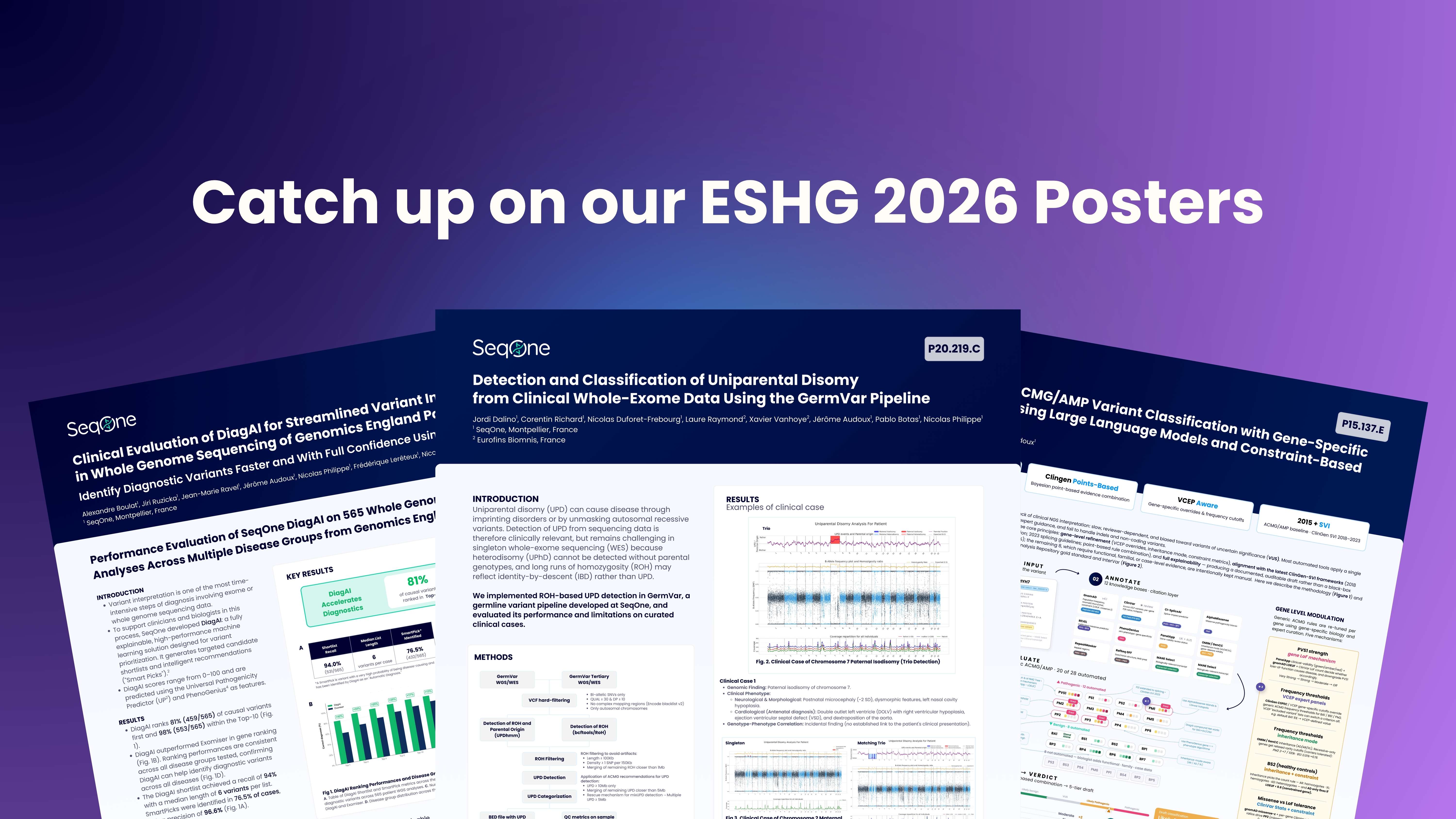
At SeqOne, science sits at the core of everything we build. Our research and development work is driven by a simple goal: giving clinicians and biologists tools they can trust to make faster, safer, and more transparent diagnostic decisions. This year at the European Society of Human Genetics (ESHG) congress, we presented three posters that reflect that mission, each tackling a distinct bottleneck in clinical genomic interpretation.
Poster 1: Clinical Evaluation of DiagAI for Streamlined Variant Interpretation in Whole Genome Sequencing of Genomics England Patients
Variant prioritization remains one of the most time-intensive steps in exome and genome analysis. This poster presents DiagAI, a fully explainable machine learning model for variant prioritization, evaluated on 565 whole genome sequencing cases from Genomics England.
Key results:
- 81% of causal variants ranked first (Top-1)
- 98% of causal variants ranked within the Top-10
- Outperformed Exomiser across every disease group tested
- Shortlist recall of 94%, with a median list length of 6 variants per case
- SmartPicks identified in 76.5% of cases, with 96.6% precision
- Full score transparency via component-level breakdowns (pathogenicity, phenotype matching, transmission and quality)
Poster 2: Automated ACMG/AMP Variant Classification with Gene-Specific Modulation Using Large Language Models and Constraint-Based Thresholds
ACMG/AMP variant classification is often slow and inconsistent, weighed down by generic, one-size-fits-all thresholds. This poster introduces a rebuilt classification engine that automates 20 of the 28 ACMG/AMP criteria by combining gene-level refinement, VCEP overrides, and the latest ClinGen-SVI frameworks.
Key results:
- 20 of 28 ACMG/AMP criteria automated (about 71%)
- Classification reached on more than 98% of benign and pathogenic variants
- 44% of pathogenic variants rescued from VUS compared to InterVar
- PM1 precision improved from 0.21 to 0.71 using AlphaMissense-derived pathogenic islands
- Pathogenic-to-benign confusion kept near zero across the ClinGen Expert Reanalysis Repository benchmark
Poster 3: Detection and Classification of Uniparental Disomy from Clinical Whole-Exome Data Using the GermVar Pipeline
This poster addresses a more elusive challenge: identifying uniparental disomy (UPD) from clinical whole-exome sequencing. The GermVar pipeline uses runs of homozygosity to detect isodisomy and large segmental UPD events, even in singleton samples without parental data.
Key results:
- Reliable detection of isodisomy and large segmental UPD in singleton WES
- Robust UPD classification in trios when parental genotypes are available
- A structured event-classification framework distinguishing single-type and mixed UPD by chromosomal coverage
- Genome-wide categorization that differentiates true UPD from background consanguinity
- Clinical case studies (including chromosome 7 paternal isodisomy and chromosome 2 maternal mixed iso-/heterodisomy) demonstrating diagnostic utility
- Outputs integrated directly into the SeqOne Platform, including LOH-tagged BED files, BAF and coverage plots, and HTML reporting
Why This Matters
Each of these projects shares a common thread: reducing diagnostic uncertainty without sacrificing rigor or transparency. We are proud to share this work with the genetics community at ESHG, and we invite you to download the full posters below to explore the methodology and results in detail.