
A 67-year-old man had surgery for gastric cancer and was due to start chemotherapy at Fondazione IRCCS Casa Sollievo della Sofferenza, a research hospital in San Giovanni Rotondo, in the south of Italy. Before his first dose, his care team ran the genetic test that European practice recommends: a check of the DPYD gene, which indicates whether a patient can safely break down the type of chemotherapy he was about to receive.
The test came back clear. He started at the full dose.
Eight days later he was in hospital with severe gastrointestinal toxicity, and later with a serious bloodstream infection. He recovered after twenty-five days, but his chemotherapy had to be stopped for good.
His care team wanted to know why, and SeqOne was glad to play a part in finding out.
The gene behind the test
Chemotherapies like capecitabine are broken down in the body by a single enzyme called DPD, produced by the DPYD gene. If that enzyme does not work well, the drug builds up and can cause severe, occasionally fatal, side effects. This affects an estimated 3% to 7% of people of European ancestry, which is why pre-treatment testing is now standard.
The usual test is fast and inexpensive. It checks a handful of specific spots in the gene where known risk variants sit. It has prevented a great deal of harm.
But it only looks at those spots.
What a closer look revealed
When the hospital's genetics team investigated further and sequenced the whole gene, a much larger problem appeared: one of the patient's two copies of DPYD was missing a 545 kb stretch, removing exons 5 to 20.
Four of the five positions checked by the routine test sit inside that missing stretch. The test had read the one remaining copy and correctly reported no variant there. The deletion itself was simply outside what that kind of test can see.
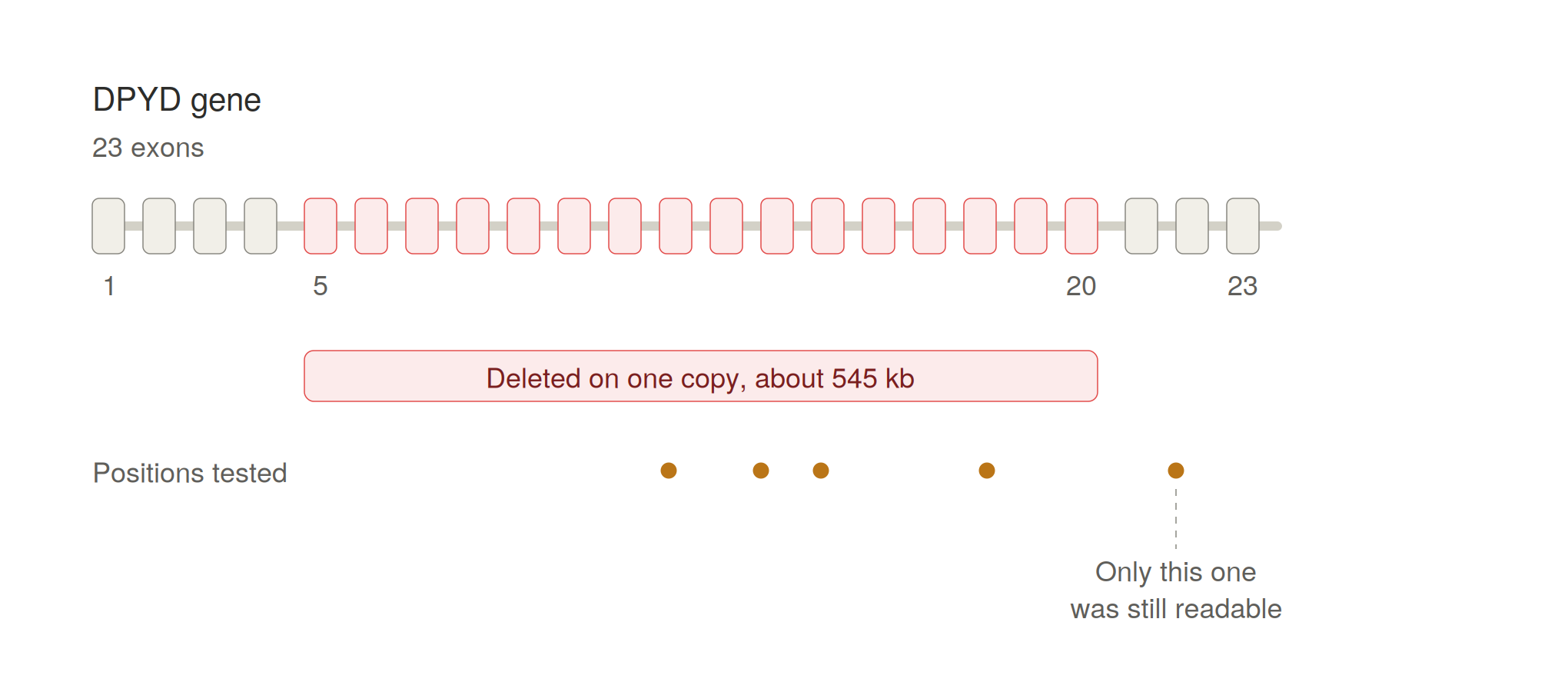
The routine test checks a small number of specific positions in DPYD. In this patient, all but one of them sat inside the deleted stretch.
Deletions like this are thought to account for around 7% of DPD deficiency cases.
How the SeqOne Platform contributed
Missing pieces of DNA are not found by looking for a changed letter. They are found by counting, comparing how much sequencing signal comes from each part of the gene against what two healthy copies should produce.
The initial analysis pointed to a deletion. Given what was at stake, the data was also run through SeqOne Platform for an independent second assessment.
The SeqOne Platform copy number analysis, built on a different method, returned exon-by-exon copy ratios of 0.43 to 0.60 across the affected region, close to the 0.5 expected when one of two copies is absent, with neighbouring exons sitting near 1.0 as they should. The pattern held steadily across many consecutive exons, which is what separates a real deletion from a quirk in the data. A SNP array confirmed the same result.
Later enzyme testing completed the picture. The patient's DPD activity was around half of normal, and his blood chemistry matched. The deletion was real, and it mattered.
Why the case is worth sharing
Helping a clinical team reach a confident answer about a patient's experience is the work that matters most at SeqOne, and contributing to this case alongside the team at Casa Sollievo della Sofferenza was a privilege.
The case also deserves to be put forward with care. Deletions of this size in DPYD are rare, and whole-gene sequencing for every patient is not yet routine or proven to be the right default. Cost, infrastructure, and consistent reporting standards are all genuine considerations.
What the case does show is simpler. "No variant found" means no variant was found among those tested. It does not always mean the gene is intact. And the methods for spotting missing sections of a gene are mature and reliable, well proven in rare disease diagnostics. There is a good case for making them part of pharmacogenetic analysis too.
For one patient, that distinction turned out to matter a great deal.
This case is published open access in Frontiers in Pharmacology (4 August 2026): doi.org/10.3389/fphar.2026.1866621. SeqOne provided independent bioinformatic confirmation of the deletion described.