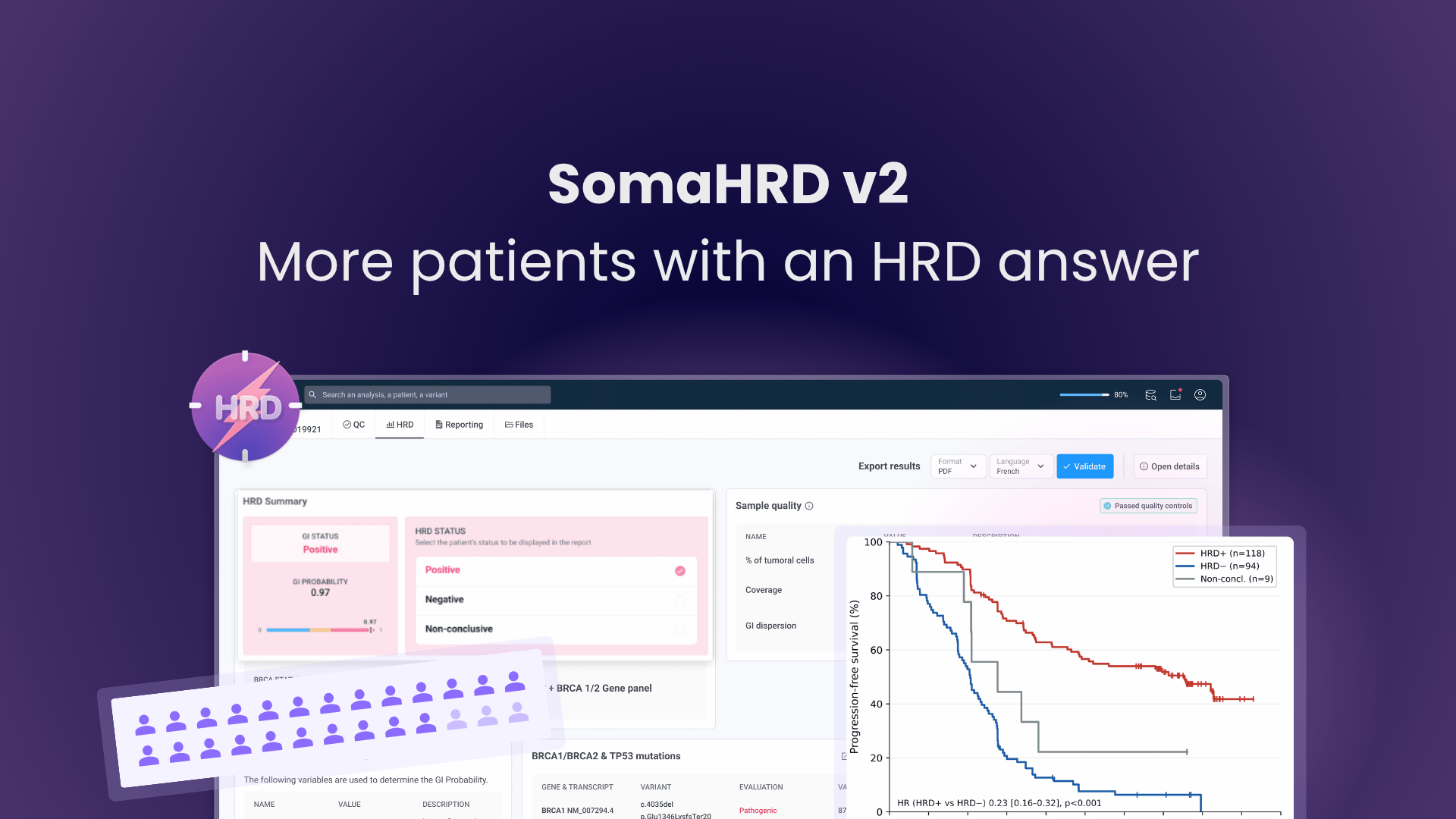
How SomaHRD v2 delivers reliable HRD results for every patient, from challenging samples to changing sequencing setups.
Homologous Recombination Deficiency (HRD) status plays a central role in PARP inhibitor treatment decisions for ovarian cancer. Around 40 to 50% of high-grade serous ovarian carcinomas are HRD-positive, but because BRCA1/2 alterations account for only about half of these cases, genomic instability (GI) scar-based testing is needed to identify the patients who would be missed by BRCA testing alone.
For laboratories bringing this testing in-house, strong performance on a validation cohort is only part of what matters. Results also need to hold up in day-to-day practice, where sequencing depth, instruments, and FFPE sample quality vary from one run to the next, and where every non-conclusive result leaves a patient without an actionable HRD status.
SomaHRD v2 was developed with both requirements in mind. Evaluated against Myriad MyChoice CDx on 355 tumor samples from the PAOLA-1 phase 3 trial, it showed 97.1% concordance and equivalent survival stratification, while assigning a definitive HRD status to 23 of the 26 samples the reference test could not call. Alongside this clinical performance, v2 brings deterministic results, built-in quality checks, and broad sequencer compatibility, so that laboratories can rely on it in routine clinical use.
Why SomaHRD v2 Matters
For each patient, an HRD result informs whether maintenance therapy with a PARP inhibitor is likely to help. The reliability of every individual result therefore matters as much as the performance measured across a cohort, and this is where SomaHRD v2 brings its most significant improvements.
The first concerns sample quality. When a sample does not contain enough tumor material, the genomic instability signal becomes harder to measure, and earlier versions of SomaHRD could return a less reliable result. SomaHRD v2 checks tumor cellularity on every sample and warns the user when it falls below what a reliable call requires, so that the biologist knows when a result needs to be interpreted with caution.
The second concerns consistency over time. Laboratories rarely keep the same setup for years: they sequence deeper, adopt new instruments such as those from Element Biosciences, or adjust their wet-lab protocols. SomaHRD v2 was built to return reproducible results through these changes, with a deterministic model, stable calls from 0.3× coverage upward, and performance evaluated on both Illumina and Element Biosciences platforms.
HRD also has no perfect black-and-white ground truth, and some samples will always sit close to the decision boundary. SomaHRD v2 handles these cases with a fixed non-conclusive band and actionability guidance flags that give the reviewing biologist additional context, and our scientific team remains available to review complex cases in depth with each laboratory.
The Numbers That Matter
Compared with Myriad MyChoice CDx on 355 tumor samples from PAOLA-1, SomaHRD v2 delivered:
- 97.1% concordance: Among the 315 samples with a definitive result from both tests, SomaHRD v2 agreed with Myriad MyChoice CDx on 306.
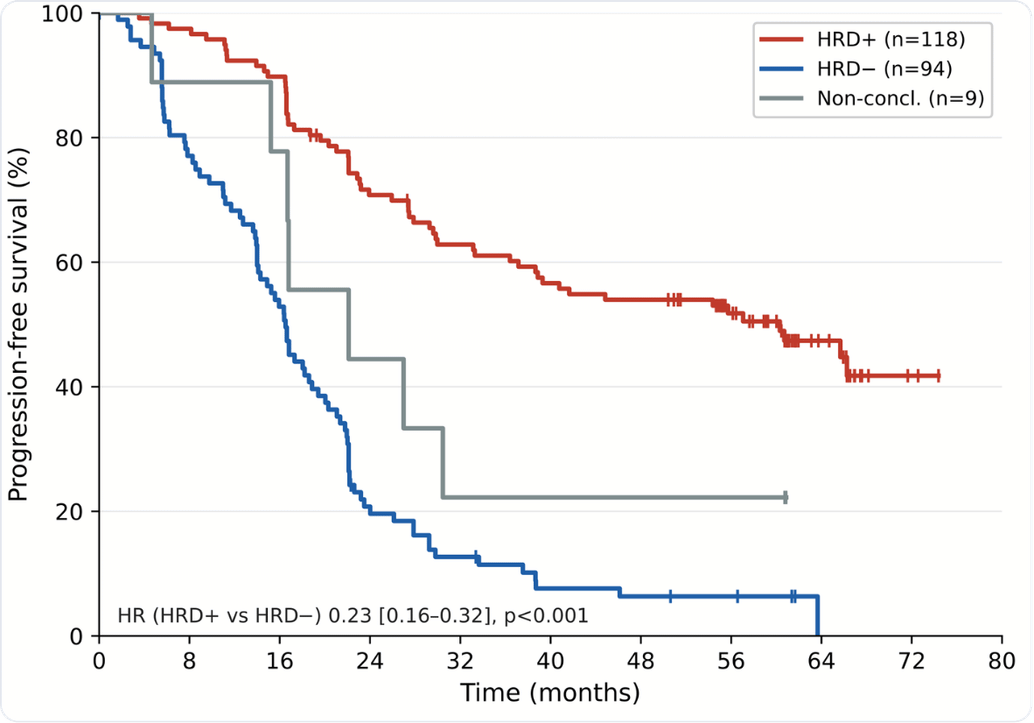
- A PFS hazard ratio of 0.23: In the olaparib arm (221 samples), HRD-positive patients identified by SomaHRD v2 showed a hazard ratio of 0.23 (95% CI: 0.16 to 0.32, p<0.001) versus HRD-negative patients, equivalent to the separation reported with the reference test in the original trial.
- 60.3 months of median PFS: HRD-positive patients in the olaparib arm reached a median progression-free survival of 60.3 months.
- A 4.8% non-conclusive rate: SomaHRD v2 returned a non-conclusive result for 17 of 355 PAOLA-1 samples, and for approximately 3% (6/199) of samples in routine clinical cohorts.
- 23 of 26 reference non-conclusives resolved: SomaHRD v2 assigned a definitive HRD status to 88% of the samples the reference test could not call.
Agreement between Myriad MyChoice CDx (rows) and SomaHRD v2 (columns) on 355 PAOLA-1 samples. NC: non-conclusive.
Metric note: Concordance is calculated on samples where both tests returned a definitive result. The v2 figures come from SeqOne's v2 validation on PAOLA-1 and should not be attributed to the earlier assay version described in the ESMO Open publication on the same cohort.
Fewer Patients Left Without an Answer
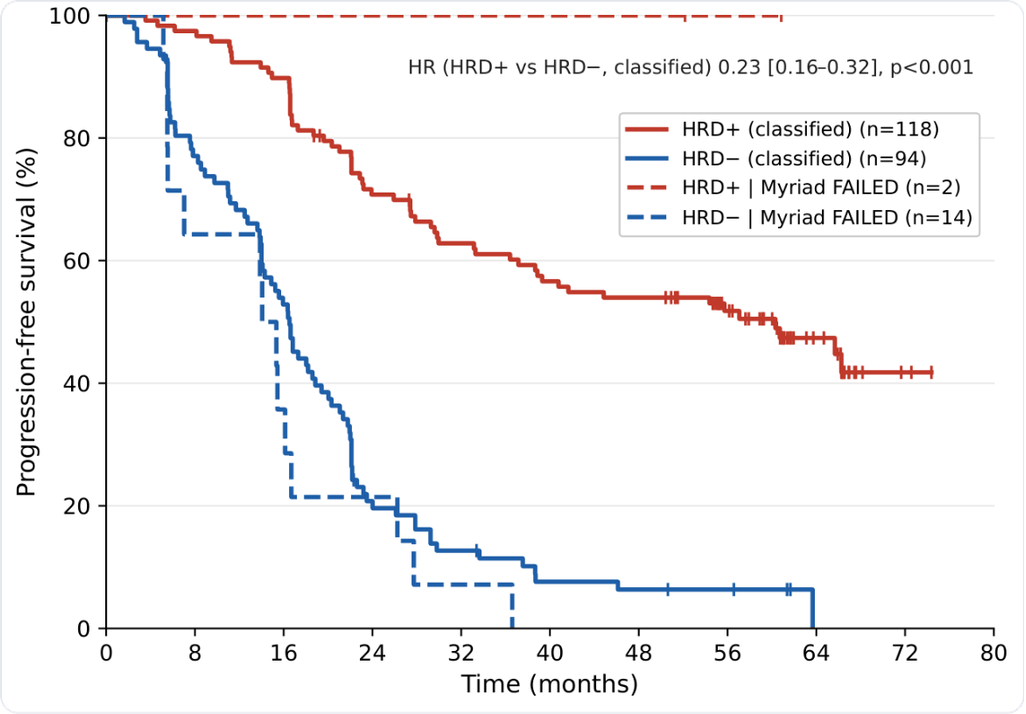
Across the PAOLA-1 cohort, the reference test returned a non-conclusive result for 26 samples. SomaHRD v2 assigned a definitive HRD status to 23 of them.
In the olaparib arm, SomaHRD v2 reclassified 16 of the 18 samples left non-conclusive by the reference test. The survival curves of these patients follow those of the HRD-positive and HRD-negative groups they joined, which confirms that the reclassified calls are clinically meaningful.
What Makes SomaHRD v2 Different
SomaHRD v2 integrates two data streams: a genomic instability probability derived from shallow whole-genome sequencing (sWGS), and a BRCA1/2 pathogenic variant assessment from an optional targeted panel. The genomic instability probability is reported even without BRCA input.
- A redesigned genomic instability model: A bagged Support Vector Machine classifier combines five features (Large Genomic Alterations, medium and large Loss of Parental Copies, tumor fraction, and ploidy) into a continuous HRD probability between 0 and 1.
- Deterministic by design: The same sample reprocessed through the pipeline returns the same call. In internal reproducibility testing, HRD probabilities varied by no more than ±0.004, and a fixed non-conclusive band between 0.4 and 0.6 provides an auditable decision rule.
- Built-in sample quality checks: SomaHRD v2 estimates the tumor fraction of every sample and warns the user when tumor content is too low for a reliable call. Results between 0.1× and 0.3× coverage carry a low-coverage warning.
- Robust across sequencers and depths: Performance was evaluated on Illumina (NextSeq and NovaSeq series) and Element Biosciences instruments, and MGI DNBSEQ is technically supported. HRD calls remain stable from 0.3× coverage upward, with optimal performance at 1×.
- Actionability guidance flags: RAD51B biallelic loss and CCNE1 amplification appear in the report as biological context for the reviewing biologist. Neither flag changes the HRD probability or the final HRD status.
- 3.6 times faster analysis: At the recommended 1× depth, median processing time drops from 150 to 41 minutes. At 0.1× and 0.3×, results arrive in under 20 minutes, compared with 75 to 94 minutes for the previous generation.
Built for Routine Clinical Labs
Laboratories such as North West GLH and Genekor Medical have shown that HRD testing can move out of send-out workflows and into routine practice. SomaHRD v2 is designed to fit the existing workflows of laboratories.
- Flexible testing options: Labs can run the BRCA1/2 panel and sWGS together, add the genomic instability analysis after the panel, or run it on its own.
- Panel-agnostic: SomaHRD v2 pairs with any BRCA/HRR panel of the lab's choice, aligned to either GRCh37 or GRCh38.
- Single-index sequencing: Panel sequencing and sWGS can be multiplexed on one flow cell, with the genomic instability score derived from off-target reads.
- Routine sample compatibility: SomaHRD v2 accepts challenging FFPE samples, with a tumor cell content requirement as low as 20% and sWGS input from 0.1× coverage.
- Integrated reporting: The clinical PDF report is available in English, French, German, Italian, and Spanish, and integrates with SomaVar and SomaCGP for a unified view of variants, biomarkers, and HRD status.
CE-IVD Marked on the SeqOne Platform
SomaHRD v2 is currently available for Research Use Only in the SeqOne Preview environment. As part of the Fall26 Main Release, it will be delivered within SeqOne Platform, a software-based Class C in vitro diagnostic medical device, CE-marked under Regulation (EU) 2017/746 (IVDR). Laboratories gain an HRD analysis that has met the safety, performance, and quality requirements of the IVDR, inside the same platform they use for their somatic workflows.
Go Deeper: Read the SomaHRD v2 White Paper
The SomaHRD v2 white paper details the genomic basis of the SomaHRD v2 score, the full PAOLA-1 analysis, the technical evaluation, a comparison with other HRD testing solutions, and the sequencing requirements for implementation in your lab.
Regulatory status may vary by region. The validation data presented applies to the same analytical engine regardless of regional configuration.