%20(1).jpg)
For a woman diagnosed with high-grade serous ovarian cancer, one laboratory result helps decide whether she is offered a PARP inhibitor. It is called HRD status, short for homologous recombination deficiency, and it describes whether her tumour has lost the ability to repair certain kinds of DNA damage. Tumours that have lost it are vulnerable to that class of drug.
Producing that result reliably, for every patient, week after week, is a laboratory problem as much as a scientific one.
A department built around integrated diagnosis
The Pathology Department at Consorcio Hospital General Universitario de Valencia brings histopathology, immunohistochemistry and molecular diagnostics together under one roof. The intent, as the team describes it, is integrated diagnosis: reading the tissue and reading the genome as parts of the same answer rather than two separate reports.
Over recent years the department has progressively brought next-generation sequencing into routine clinical service, particularly for the molecular characterization of solid tumors. Its work is accredited to ISO 15189 for advanced molecular diagnostics by NGS, covering somatic alterations including single nucleotide variants, indels, copy number variants and gene fusions, along with specific oncology applications such as HRD status in ovarian cancer.
That accreditation shapes how the team thinks about new methods.
"As genomic studies grow more complex, we consider it especially important to have standardized, traceable and reproducible workflows that guarantee the quality of the diagnostic process," says Maria Colomar-Roig, Clinical Laboratory Geneticist in the pathology department.
The reason for the change
When the department looked at how to run HRD testing at scale, the deciding factor was not a feature on a specification sheet.
"The main factor was workflow automation," Colomar-Roig says. "It was essential for us to reduce manual tasks as far as possible, and with that, to reduce the risk of error and the variability between operators. Combining the Agilent solution with SeqOne gives us a more automated and robust workflow while keeping expert review of the results."
That last clause matters. The goal was never to remove the laboratory technician from the process. It was to remove the repetitive handling steps around them, so that expert attention lands where it is actually needed.
The workflow the department implemented pairs the Agilent SureSelect CD HRR17 panel, with library preparation automated on the Agilent Magnis system, with analysis on the SeqOne platform using its SomaHRD and SomaVar modules.
They did not take it on trust
Rather than adopt the workflow and assume it performed, the team benchmarked it and published what they found.
They went back through 30 high-grade serous ovarian carcinoma cases diagnosed at the hospital between 2019 and 2023. Every case was re-analyzed with the in-house workflow, and the results were set against whichever established commercial assay had been used during that patient's actual clinical care.
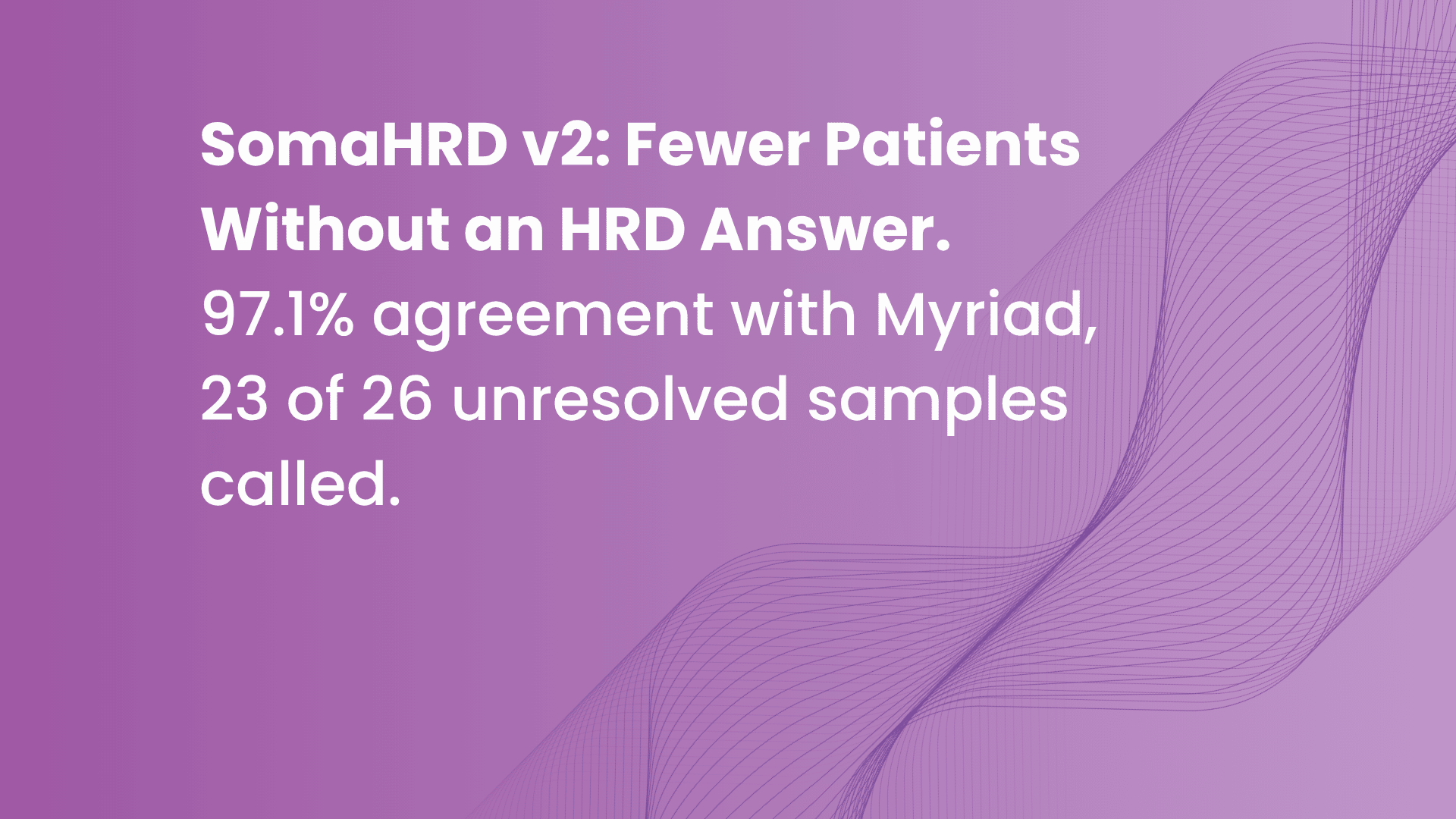
Among cases where both approaches returned a usable result, the classifications agreed. The underlying instability scores tracked each other closely as well, despite each method calculating them differently, and the variant allele frequencies were closely aligned.
A second finding was more practical. The proportion of cases that produced no usable answer at all was lower with the in-house workflow, at around 10% of the cohort. The study is small and the authors are careful not to overstate the difference, but inconclusive results are the ones that generate repeat testing and delay, so the direction of travel is the one a working lab cares about.
"The solution has made the process more automated, standardized and reproducible, reducing manual intervention and making it easier to prioritize and interpret the clinically relevant alterations," Colomar-Roig says. "A clear example is the reduction in the number of inconclusive results."
What holding the data makes possible
One advantage only became visible with time. Because the hospital keeps its own sequencing data, cases can be revisited when the analysis software is updated.
That happened during the study. A borderline case was reclassified after a new version of SomaHRD changed how it estimates confidence around the classification threshold. The genomic data had not changed; the understanding of its uncertainty had. Being able to act on that is a quiet benefit of keeping the analysis in the building.
Turnaround time is the more visible one. Results that previously took around twenty days now come back in roughly six or seven, and the automated library preparation cut hands-on time from several hours to about 45 minutes. The workflow also proved tolerant of lower DNA input and lower tumour cellularity, which matters when the available tissue is limited.
A working partnership
Asked what she would tell a colleague considering the same setup, Colomar-Roig keeps it brief: automation, fewer errors and inconclusive results, and reproducibility.
SeqOne is grateful to the team in Valencia, not only for choosing the platform but for testing it rigorously and publishing the result. Independent evaluation by the labs who use a tool every day is how clinical software earns its place, and it is how the platform gets better.
The study is published open access in Biomedicines (22 June 2026): doi.org/10.3390/biomedicines14061405.
Quotations have been translated from Spanish.
Want to find out more about SeqOne's SomaHRD solution?
Read our latest white paper!
Regulatory status may vary by region. The validation data presented applies to the same analytical engine regardless of regional configuration.