Sequencing a baby's genome at birth can lead to a diagnosis much earlier than today's standard of care. But making it work looks very different in a population screening program, where cost per sample is critical, and in a NICU, where families need answers within days.
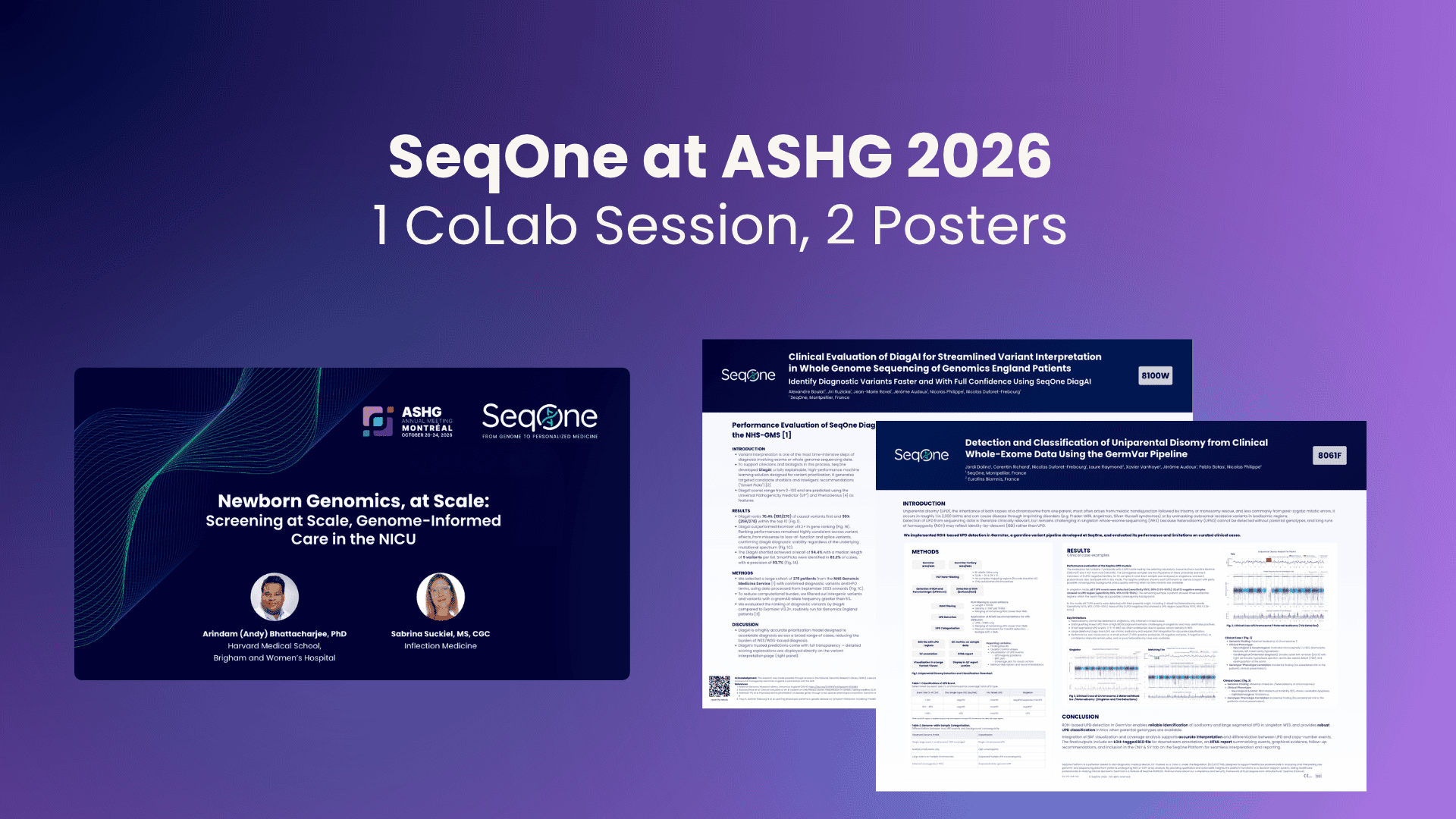
At ASHG 2026 in Montreal, we invited speakers from Brigham and Women's Hospital and Inflection Medicine to share how they approach each of these settings during our CoLab session. You can watch the full recording below, along with the two posters our team presented during the meeting, on DiagAI and on UPD detection with GermVar.
CoLab Session: Newborn Genomics, at Scale: Screening at Scale, Genome-Informed Care in the NICU
Speakers:
- Andy Bhattacharjee, PhD, Assistant Professor of Pediatrics at Harvard Medical School and Brigham and Women's Hospital, presents a feasibility study on genomic newborn screening from dried blood spots. Rather than sequencing each baby on their own, his team pools DNA from many samples and then traces each variant back to the right baby, bringing the cost per sample down.
- Sabrina Suckiel, MS, CGC, Clinical Science Lead at Inflection Medicine, looks at why so few NICU babies benefit from genome sequencing today, and how a rapid genome paired with clear clinical guidance helps care teams act on the results.
Poster 1: Clinical Evaluation of DiagAI for Streamlined Variant Interpretation in Whole Genome Sequencing of Genomics England Patients
Variant interpretation is one of the most time-consuming steps in exome and genome analysis. This poster evaluates DiagAI, SeqOne's fully explainable machine learning model for variant prioritization, on 270 whole genome sequencing singleton analyses across 167 genes from the NHS Genomic Medicine Service. DiagAI was compared with Exomiser v13.2+, which is routinely run for Genomics England patients.
Key results:
- 70.4% of causal variants ranked first (190/270)
- 96% of causal variants ranked within the Top-10 (259/270)
- Outperformed Exomiser v13.2+ in gene ranking
- Consistent performance across variant effects, from missense to loss-of-function and splice variants
- Shortlist recall of 94.4%, with a median list length of 5 variants per case
- SmartPicks identified in 82.2% of cases, with 93.7% precision
- Full score transparency via component-level breakdowns (pathogenicity, phenotype matching, transmission and quality), displayed directly on the variant interpretation page
Poster 2: Detection and Classification of Uniparental Disomy from Clinical Whole-Exome Data Using the GermVar Pipeline
Uniparental disomy (UPD) occurs in roughly 1 in 2,000 births and can cause imprinting disorders or unmask recessive variants. It remains hard to detect in singleton exomes. This poster, developed with Eurofins Biomnis, presents ROH-based UPD detection in GermVar and measures its performance on clinically confirmed cases, analysed both as singletons and as trios.
Key results:
- All 7 confirmed UPD events detected in singleton mode (sensitivity 100%), with 22 of 23 negative samples showing no UPD region (specificity 96%)
- All 7 UPD events detected in trio mode with their parental origin, including 2 mixed iso-/heterodisomy events, and no UPD region in the 3 negative trios
- A classification framework that separates single-type and mixed UPD by chromosomal coverage, and distinguishes true UPD from background consanguinity
- Clinical cases illustrating detection, including chromosome 7 paternal isodisomy and chromosome 2 maternal mixed iso-/heterodisomy
- Outputs integrated into the SeqOne Platform: LOH-tagged BED file, HTML report with BAF and coverage plots, and display in the CNV & SV tab
Thank You, Montreal
A big thank you to Andy and Sabrina for sharing their work with us, and to everyone who came by our posters and our booth during the week.