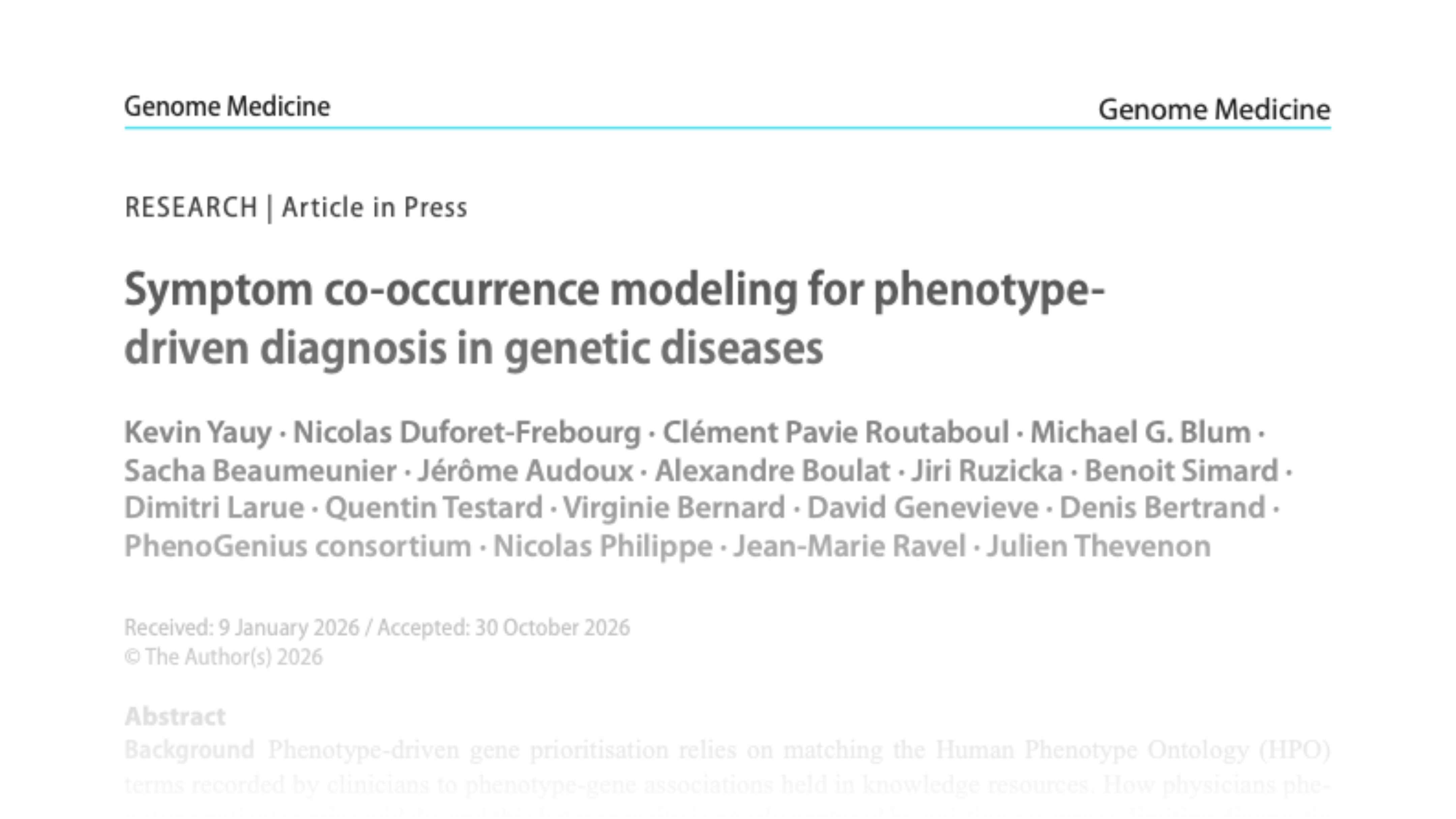
Symptom Co-occurrence Modeling for Phenotype-Driven Diagnosis in Genetic Diseases
Sequencing can return hundreds of candidate genes, and it is often the patient’s symptoms that point to the right one. Yet no two clinicians describe the same patient in the same way, and most phenotype-matching tools only recognize symptom-gene links already recorded in knowledge bases.
A new peer-reviewed study in Genome Medicine shows how PhenoGenius, part of our Genomic Intelligence stack, closes that gap. Across 1,686 patients with a confirmed genetic diagnosis:
- Standard HPO databases covered only 43% of the symptom-gene associations recorded by clinicians. By learning which symptoms tend to occur together in genetic diseases, PhenoGenius covered 98.4%.
- PhenoGenius ranked the causal gene at a median position of 35, compared with 65 for CADA, the best of seven established tools. This advantage held in each of the four cohorts.
- PhenoGenius placed the causal gene within the top 500 candidates for 87.0% of patients, the highest rate among the ten methods tested.
In practice, phenotype matching holds up even when a clinical description is brief or uses less common terms, so the causal gene stays on the shortlist clinical scientists review.
Read the full study to learn how PhenoGenius groups 16,600 HPO terms into 390 patterns of co-occurring symptoms, and how it performs against seven established tools and two reasoning language models.